Vital Statistics During the 1918 Influenza Pandemic
My previous post discussed 1918 vaccine studies, whose reliance on anecdotal evidence led to erroneous determinations of effectiveness. Shortcomings of the 1918 vaccine trials spurred statistical research on designing vaccine studies that ultimately led to the rigorous designs used today.
Another statistical issue that hindered response to the 1918 pandemic was the lack of accurate, timely statistics about influenza cases and deaths. Some cities and states attempted to keep statistics of deaths, but only 33 states participated in the US Vital Statistics system.
Vital statistics are exactly what the name implies: statistics related to life events. These typically include statistics about births, deaths, marriages, and divorces. In 1918, death statistics were needed to know the extent of fatalities caused by the influenza pandemic. Let’s look at the death statistics available in 1918 and how they led to today’s Vital Statistics systems.
Vital Statistics in 1918
Schedule 3 of the 1850 census asked for a list all of the persons in the family who had died in 1850, along with their age, sex, color, occupation, and cause of death. This marked the first time the US government attempted to collect mortality statistics for all states, but the “reports were inaccurate and incomplete, and it became evident that reliable data could be obtained only from States and large cities that had efficient systems for the registration of these events” (Hetzel, 1997, p. 9).
The Bureau of the Census established a “national registration area” for deaths in 1880. At first the registration area contained only two states (Massachusetts and New Jersey), but more states were admitted as they met the requirements of (1) adopting the standard death certificate, (2) enacting a Model State Vital Statistics law that specified registration procedures and duties of state registrars, and (3) establishing that at least 90 percent of deaths were captured by the system. In 1918, 33 of the 48 states, accounting for approximately 3/4 of the US population, had been admitted to the national registration area for deaths (see Figure 1).
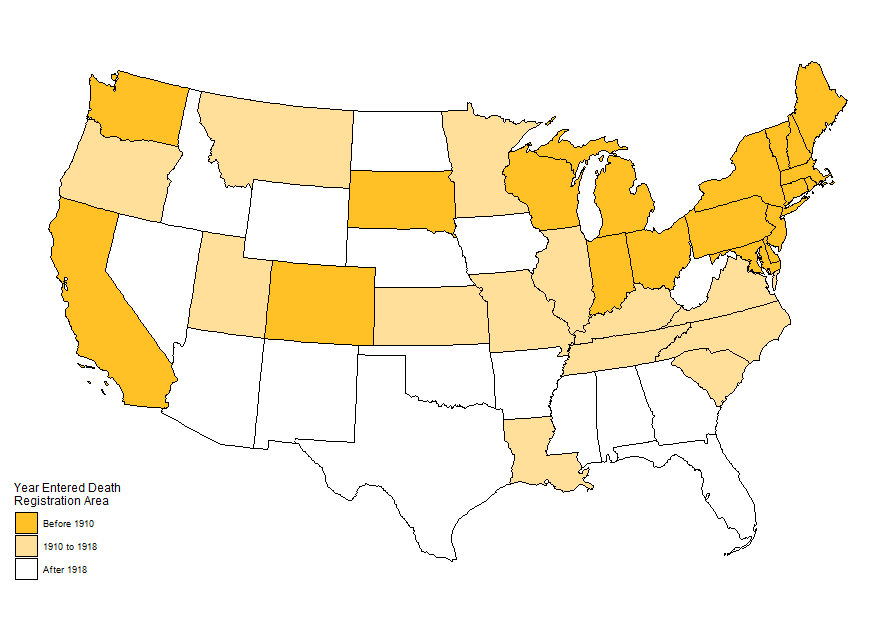
Figure 1. States in national death registration area, 1918. Dates of entry are from Dunn (1936)
But wait a minute. A state could easily establish that it had enacted the model law and adopted the standard death certificate, but how could it verify that its registration system captured at least 90 percent of deaths? The registrar was supposed to record all known deaths. How could he¹ know about deaths that were unrecorded by the system?
Davis (1925, p. 399) wrote that a version of capture-recapture estimation was used: “by obtaining from postmasters, rural carriers, and the clergy names of decedents in certain specified months. These names were then checked against the names on file in the official records of the state. If 90 per cent of the names thus gathered from the rural carriers and others were found on file the state was admitted to the area.” But then state vital registration systems started relying on additional data from postmasters, rural carriers, and the clergy so that their information would be captured in the death statistics system (and could no longer be used to check its accuracy).
In the mid-1920s, the Bureau of the Census switched to another method of estimating the percentage of state deaths captured by the registration system. They sent return-postage-paid postcards directly to households, asking the respondent to fill in the name and death date of anyone in the household who had died in the last 12 months.
Both of these methods would likely overestimate the percentage of deaths captured by the vital registration system. Wilbur (1916) admitted that “Even for the registration area for deaths as at present constituted, we do not have full assurance that the registration is uniformly complete in all states. The standard of admission is low—90 per cent—and the means of testing the compliance therewith are inadequate.” Davis (1925) commented on the unusually low death rates in several of the recently admitted southern states. It is quite likely that some states in the death registration areas were missing more than 10 percent of their deaths.
The influenza pandemic, however, highlighted the inadequacy of the available statistics and spurred research on their improvement. Dunn (1936, p. 349) commented that the “need for new methods of testing completeness of registration is one of the most vital problems confronting the vital statistician.”²
Vital Statistics Today
By 1933, all 48 states had qualified to be part of the national death registration area. Compiling statistics was slow, however, because all records were on paper, and death statistics were typically released with a two-year time lag. In the early 2000s, the National Vital Statistics System (NVSS) began switching over to electronic systems. The National Center for Health Statistics (2021) reported on some of the improvements to the NVSS resulting from data modernization efforts, including improved data quality and more complete information on causes of death.
The final reports on mortality still have a nearly two-year lag, however. Provisional statistics are available earlier, but the most recent provisional death statistics are from fourth quarter, 2024 for deaths from all causes and from third quarter, 2024 for deaths from specific causes such as homicide — almost a year after the last events of 2024.
Vital statistics are integrated into so many processes and assessments of the nation’s health that they are often taken for granted (National Research Council 2009, p. 3). The lack of comprehensive vital statistics during the 1918 pandemic severely impeded the ability of the US public health system to deal with the pandemic and its aftermath, and estimates of deaths from the pandemic have large measures of uncertainty. But one result was increased cooperation between local, state, and federal governments in developing and improving the NVSS. The NVSS modernization program requires resources and continued cooperation and trust to achieve its goal “to transform the National Vital Statistics System into a tool for real-time public health surveillance.”
Copyright (c) 2025 Sharon L. Lohr
Footnotes and References
¹I use the pronoun “he” because official state registrars were men, but in several states women actually collected the statistics. When Arizona was admitted into the death registration area in 1926, the statistician who collected and tallied the death statistics was a woman named Ruby Jacquemin.
²Halbert Dunn was the Chief of the Vital Statistics Office from 1935 to 1960. His most famous contribution to statistics, however was in another area: he founded the research area of record linkage. Dunn (1946) wrote that each person has a Book of Life but sometimes the Book is difficult to read because records are recorded in different places. He gave the name “record linkage” to the process of “assembling the pages of this Book into a volume.”
Davis, W.H. (1925). Necessity for completing the registration area by 1930. American Journal of Public Health, 15(5), 399-404.
Dunn, H.L. (1936). Vital statistics collected by the government. The Annals of the American Academy of Political and Social Science, 188, 340-350.
Dunn, H. L. (1946). Record linkage. American Journal of Public Health , 36(12), 1412-1416.
Hetzel, A.M. (1997). History and Organization of the Vital Statistics System. Hyattsville, MD: National Center for Health Statistics.
Jester, B., Uyeki, T. M., Jernigan, D. B., & Tumpey, T. M. (2019). Historical and clinical aspects of the 1918 H1N1 pandemic in the United States. Virology, 527, 32-37.
National Center for Health Statistics (2021). National Vital Statistics System Improvements. https://stacks.cdc.gov/view/cdc/107288
National Research Council. (2009). Vital Statistics: Summary of a Workshop. Michael J. Siri and Daniel L. Cork, rapporteurs. Committee on National Statistics, Division of Behavioral and Social Sciences and Education. Washington, DC: The National Academies Press.
Wilbur, C. L. (1916). The Federal Registration Service of the United States. Washington, DC: US Government Printing Office.