Thomas Jefferson and Population Estimates
In June 1826, Thomas Jefferson was too ill to accept the Washington DC mayor’s invitation to participate in the fiftieth anniversary celebrations of the Declaration of Independence. In his polite letter declining the invitation, Jefferson wrote of his hopes for the document he had authored:
May it [the Declaration of Independence] be to the world, what I believe it will be, (to some parts sooner, to others later, but finally to all,) the signal of arousing men to burst the chains under which monkish ignorance and superstition had persuaded them to bind themselves, and to assume the blessings and security of self-government. That form which we have substituted, restores the free right to the unbounded exercise of reason and freedom of opinion. All eyes are opened, or opening, to the rights of man. The general spread of the light of science has already laid open to every view the palpable truth, that the mass of mankind has not been born with saddles on their backs, nor a favored few booted and spurred, ready to ride them legitimately, by the grace of God. These are grounds of hope for others. For ourselves, let the annual return of this day forever refresh our recollections of these rights, and an undiminished devotion to them. (Jefferson, 1826; see Figure 1 for the full letter).
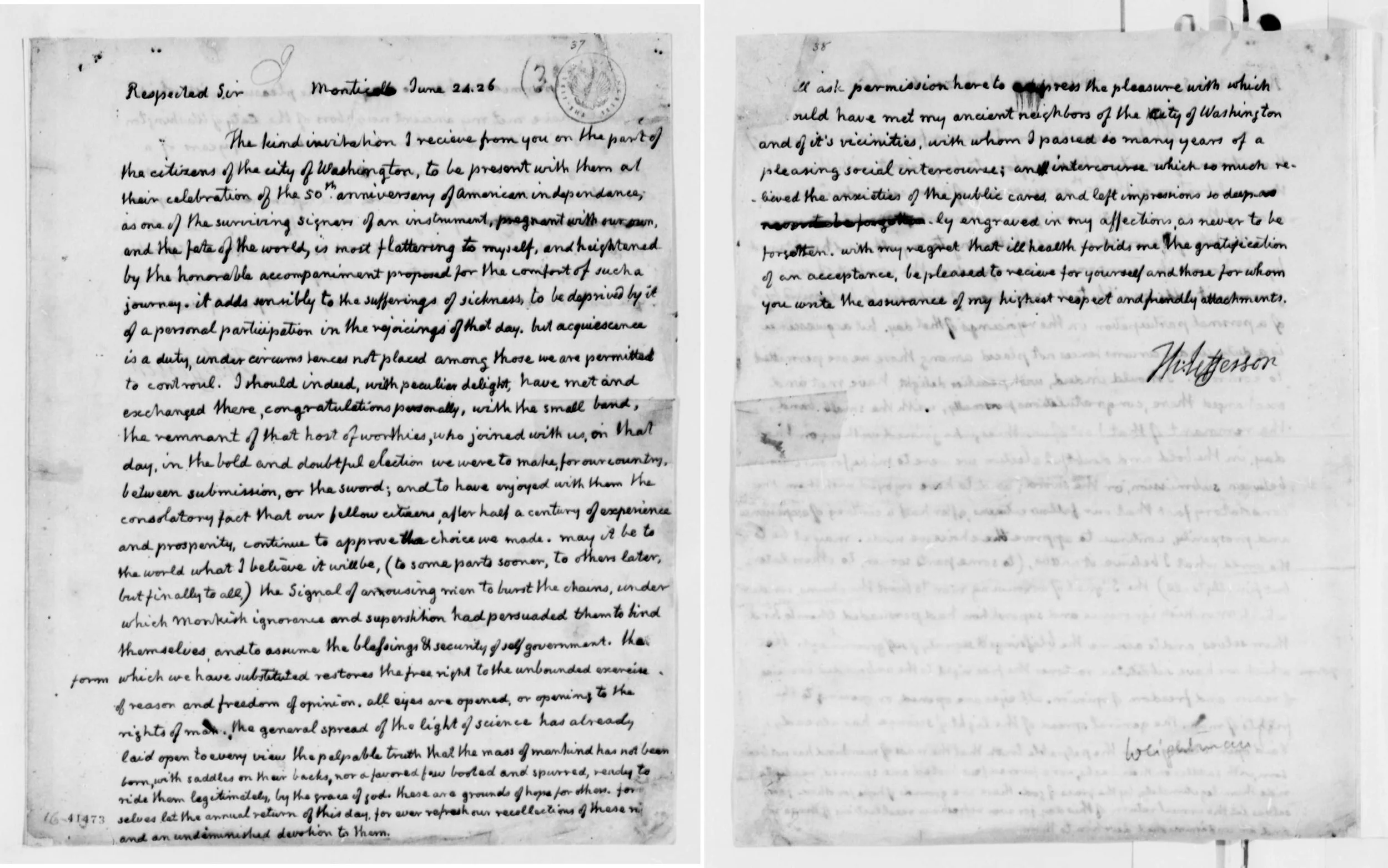
Figure 1. Letter from Thomas Jefferson to Roger Weightman, mayor of Washington DC, June 24, 1826. Source: https://www.loc.gov/item/mtjbib024904/.
Jefferson died 10 days after writing the letter, on July 4, 1826 —- exactly 50 years after the Declaration was signed. It is typical that Jefferson’s last letter extols “the general spread of the light of science,” as Jefferson was a lifelong scientist and supporter of science. Upon leaving the presidency, Jefferson wrote to Pierre du Pont de Nemours: “Within a few days I retire to my family, my books & farms. . . . nature intended me for the tranquill pursuits of science, by rendering them my supreme delight” (Jefferson, 1809).
Science to Jefferson included the branches of knowledge we now include in statistical science. He collected data throughout his life. Martin (1952, p 3) wrote: “Though chiefly motivated by considerations of utility he appreciated statistics, techniques, principles, and cultural or aesthetic experiences as values in themselves.” Cassedy (1969, p. 225) argued that “probably no one in America was more imbued with the statistical spirit than was Jefferson.”
Jefferson collected statistics on any topic that piqued his interest, which included almost any topic as his interests “ranged over such fields as meteorology, paleontology, ethnology, archaeology, astronomy, chemistry, agriculture, geology, exploration, botany, medicine, and inventions” (Martin, 1952, p. x). Once, when stranded by heavy rain with “nothing but an almanack to read” (and without his pocket-book of logarithms!) he whiled away the hours by computing how long it would take to pay off the national debt (Martin, 1952, p. 20; Randall, 1858, p. 341).
Jefferson was a statistician in the original sense of the word — from the neo-Latin statisticum (“of the state”) and the German Statistik, coined in 1748 to describe the analysis of data pertaining to the state (Ferguson, 2022). Like Franklin, Jefferson was interested in population statistics and he was responsible for two early sets of U.S. population estimates. The first set, compiled just after the end of his term as governor of Virginia, related to the population of that state. The second set was for the entire United States, when Secretary of State Jefferson superintended the first decennial census. Let’s look at Jefferson’s role in these data collections.
Population of Virginia
Jefferson’s Notes on the State of Virginia, written in 1781-82 in response to a set of queries from the secretary of the French delegation to the United States, compiled data on Virginia’s natural resources and economy (Jefferson, 1823; Dikant, 2019). Query VIII concerned the number of inhabitants of each state. Jefferson needed to estimate this, as there was no reliable census of Virginia’s population.
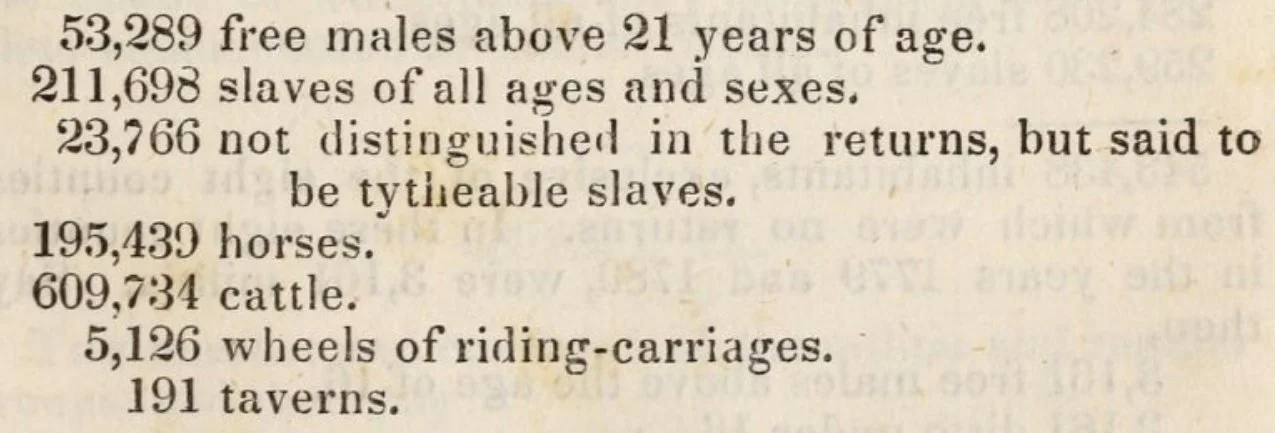
Figure 2. Jefferson’s list of “taxable articles,” used as the starting point for his estimate of the population of Virginia in 1782 (Jefferson, 1823, p. 91).
Jefferson provided a figure of 567,614 inhabitants for 1782 and wrote: “It will be proper to explain how the numbers for the year 1782 have been obtained; as it was not from a perfect census of the inhabitants. It will at the same time develope the proportion between the free inhabitants and slaves.” (Jefferson, 1823, p. 91). He started with the return of “taxable articles” for 1782, shown in Figure 2.
The statistics in Figure 2 were from returns used in tax assessments and provided population counts only for the heads of households (the free males over age 21) and for enslaved persons, who were considered taxable property. They did not include counts of free women and free males under age 21, or counts from eight counties for which tax returns were unavailable. Jefferson searched historical accounts and public records to find additional data sources that would give population ratios that could be used to estimate the missing counts.
First, Jefferson mentions that “some observations on a previous census had given reason to believe that the numbers above and below 16 years of age are equal” (Jefferson, 1823, pp. 91-92). He therefore doubles the count of 23,766 “tytheable slaves” (those age 16 and over) and adds that number to 211,698 to arrive at an estimate of 259,230 enslaved persons. He uses the same assumption to estimate the number of free males under age 21 as 2(53,289 + number of free men between ages 16 and 21), “[b] ut as the number 53,289 omits the males below 16 and 21 we must supply them from conjecture” (Jefferson, 1823, p. 92). Previous data had shown that “about one third of our militia, that is, of the males between 16 and 50, were unmarried” and he conjectures that “ the unmarried part of our militia are those between 16 and 21. If there be young men who do not marry till after 21, there are many who marry before that age. But as the men above 50 were not included in the militia, we will suppose the unmarried, or those between 16 and 21, to be one-fourth of the whole number above 16” (Jefferson, 1823, p. 92). This gives an estimated 17,763 free men between 16 and 21, leading to an estimate of 142,104 free males of all ages. Doubling that number (to account for women) and adding it to the estimate of enslaved persons gives an estimate of 543,438 persons in the counties for which returns were available. He then estimates the population counts for the 8 counties with missing data using militia records (assuming every free male above age 16 was in the militia) along with conjectures of the ratio of men above age 16 to men below age 16 and the ratio of free to enslaved persons, to arrive at his final estimate of 567,614 persons in Virginia.
Jefferson knew that his estimate was based on strong assumptions but did the best that he could with the available data. The first decennial census in 1790 gave Virginia’s population as 747,610 (U.S. Bureau of the Census, 1908). The population in 1790 would be expected to be greater than that in 1782. Is Jefferson’s number consistent with the 1790 census under a reasonable rate of population growth?
Benjamin Franklin had conjectured in 1751 that the U.S. population could be expected to double every 20 years. Jefferson (1787), trying to persuade the French Minister of Foreign Affairs under Louis XVI that the United States was a worthy trading partner because of the rapid growth of its population and markets, relied on the same arguments as Franklin: “A century’s experience has shewn that we double our numbers every twenty or twenty-five years.” Starting with Jefferson’s estimate of 567,614 persons in 1782, the following population would be expected in 1790 under various doubling rates (the value of 23.7 is derived empirically from decennial population estimates between 1700 and 1900):
| Years Required for Population Doubling | 20 years | 23.7 years | 25 years |
| Projected Population in 1790 | 748,971 | 717,243 | 708,570 |
Jefferson's estimated 567,614 persons in 1782 would be expected to grow to 567,614 x 2(8/20) = 748,971 persons after 8 years if the population doubled every 20 years — very close to the 1790 census value of 747,610. But of course the 1790 census had inaccuracies as well, and both Jefferson's 1782 estimates and the 1790 census statistics were likely underestimates.
First Decennial Census
Article I of the U.S. Constitution established the decennial census, but did not specify how it should be conducted, saying that the enumeration was to be conducted “in such Manner as they [Congress] shall by Law direct.” Congress approved “An Act providing for the enumeration of the Inhabitants of the United States” on March 1, 1790. This act directed U.S. Marshals to “cause the number of the inhabitants within their respective districts to be taken” and enumerate persons within five categories: free while males age 16 and older, free white males under age 16, free white females (any age), other free persons, and slaves. Enslaved persons were placed in a distinct category because, according to the Constitution, each counted only as 3/5 of a person when apportioning representatives to states. Native Americans “not taxed” were not counted at all.
The Act called for the Marshals to “transmit to the President of the United States, the aggregate amount of each description of persons within their respective districts.” George Washington delegated the responsibility of administering the census to Jefferson, his Secretary of State.
According to Anderson and Fienberg (1999), Jefferson’s involvement in the census appears to have been concentrated on compiling and publishing the returns. His staff at the State Department consisted of at most six men (compared with 70 in Hamilton’s Treasury Department), and Jefferson’s Department was also responsible for conducting foreign policy, negotiating treaties, publishing legislation that was enacted, authenticating and preparing copies of records, having custody of papers of Congress, and reviewing patent applications. These responsibilities would not have left much time for census activities, even for someone as energetic as Jefferson.
Wright and Hunt (1900, p. 17) wrote that “in 1790, it is to be presumed that the Secretary of State, acting under the direction of the President, sent to each marshal copies of the act prescribing the inquiries to be made concerning each family and the manner in which they were to make their returns. An inquiry at the State Department has revealed no further information, and the conclusion is inevitable that, in all probability, the marshals were left practically to carry out the provisions of the act in their own way.”
Little is known about the procedures used by individual marshals to collect data. They were required to post the information publicly so that residents could make corrections, and the Census Act prescribed penalties for false or late returns. Most marshals met their deadlines, although South Carolina was given an extension because, as Washington told Congress, one of the assistants “made a sudden Elopement to St Augustine with all his returns.”
Jefferson did not distribute schedules for the marshals to use when collecting data. He did, however, ask William Blount, the governor of the Southwest Territory (now Tennessee), to conduct a census of the Territory even though this was not required. As there was no budget for a census of the Southwest Territory, Jefferson suggested using sheriffs to conduct the enumeration:¹
As the census of all the rest of the union will be taken in the course of this summer, and will not be taken again under ten years, it is thought extremely desireable that that of your government should be taken also, and arranged under the same classes as prescribed by the act of Congress for the general census. Yet that act has not required it in your territory, nor provided for any expence which might attend it. As, however, you have sheriffs who will be traversing their districts for other purposes, it is referred to you to consider whether the taking the census on the general plan, could not be added to their other duties, and, as it would give scarcely any additional trouble, whether it would require any additional reward, or more than some incidental accomodation or advantage, which perhaps it might be in your power to throw in their way. The returns by the sheriffs should be regularly authenticated, first by themselves, and then by you, and the whole sent here as early in the course of the summer as practicable. (Jefferson, 1791a).
Jefferson published the preliminary statistics from the 1790 census on October 24, 1791, in much the same form as he received them from the marshals (Ruggles and Magnuson, 2023). After receipt of the South Carolina statistics, the U.S. population was recorded to be 3,929,214. Both Jefferson and Washington, however, thought that this was an underestimate.
In a letter to David Humphreys, the U.S. minister to Portugal, Jefferson wrote: “Nearly the whole of the states have now returned their census. I send you the result, which as far as founded on actual returns is written in black ink, and the numbers not actually returned, yet pretty well known, are written in red ink. Making a very small allowance for omissions, we are upwards of four millions; and we know in fact that the omissions have been very great” (Jefferson, 1791b). Jefferson made a similar claim in a letter to William Short, writing that the population was “probably above 4,100,000.”
Was Jefferson correct that the census figure was an underestimate? Washington (1791) provided some of the reasons for thinking so: “our real numbers will exceed, greatly, the official returns of them; because the religious scruples of some, would not allow them to give in their lists; the fears of others that it was intended as the foundation of a tax induced them to conceal or diminished theirs, and thro’ the indolence of the people, and the negligence of many of the Officers numbers are omitted. The authenticated number however is far greater, I believe, than has ever been allowed in Europe, and will have no small influence in enabling them to form a more just opinion of our present and growing importance than has yet been entertained there.”
A number of modern scholars agree with Washington and Jefferson that the 1790 census missed portions of the population. Even 21st century censuses undercount parts of the population, and the difficulties of capturing everyone were compounded in 1790 by the wide population dispersion, poor travel conditions, untrained census-takers, and people’s distrust of the census (for religious reasons or fear that it will be used to increase taxes) and the marshals (who also conducted arrests and seizures); see Steckel (1991), Anderson (2015), and National Academies of Sciences, Engineering, and Medicine (2023).
Census undercounts today are evaluated using external data sources (see Box 4.1 of National Academies of Sciences, Engineering, and Medicine, 2023). In a post-enumeration survey, special intensive efforts are made to count everyone in a probability sample of areas and the survey results for those areas are compared with those from the census. In demographic analyses, census counts are compared with estimates computed from birth, death, and migration records. Census records can also be matched with Social Security or other administrative records to estimate the number of people missing from each source. None of these methods is error-free, as the first fails to capture people missed by both the census and the similar survey methodology, the second is affected by errors in the population records, and the third misses people in neither data source and is also subject to data linkage errors. But the multiple methods give an idea of which parts of the population are undercounted or overcounted in the census.
We cannot go back in time and take a post-enumeration survey of the 1790 census. But historians have projected population sizes using demographic analysis (see, for example, King and Magnuson, 1995; Haines, 2000; Hacker, 2013) and have compared census schedules with church and tax records (see, for example, Klepp, 1989; Smith and Sivitz, 2016). Such comparisons cannot be done everywhere, as many communities have few other records and the original detailed census schedules for Delaware, Georgia, Kentucky, New Jersey, Tennessee, and Virginia were destroyed during the War of 1812.
Jefferson estimated a net undercount of 4.4 percent for the 1790 census. We will never know the exact count for 1790, but Jefferson’s view that the the 1790 census underestimated the population is consistent with later research such as that reported in Hacker (2013) and O’Hare (2019).
Data and Democracy
Jefferson promoted the keeping of accurate statistics in his personal endeavors and for the young United States. A memorial sent to Congress by the American Philosophical Society (and signed by its president, Thomas Jefferson) in 1800 argued for expanding the topics in the census to present “a more detailed view of the inhabitants of the United States” including information on age, citizenship, and occupation (Jefferson, 1800; Wright and Hunt, 1908, p. 19). Congress rejected these suggestions for the 1800 census, but later censuses (and much later, the American Community Survey) collected information on these and other expanded topics.²
This post focused on just one small part of Jefferson’s statistical activities. Martin (1952) details some of Jefferson’s other data-keeping activities and Volić (2024) describes Jefferson’s method of Congressional apportionment (still used today in several countries).
It is not surprising that Jefferson’s last official letter promoted his faith in science and hope for democracy. Twenty-one months before he became president, Jefferson wrote:
It is impossible for a man who takes a survey of what is already known, not to see what an immensity in every branch of science yet remains to be discovered…. great fields are yet to be explored to which our faculties are equal, & that to an extent of which we cannot fix the limits. I join you therefore in branding as cowardly the idea that the human mind is incapable of further advances. this is precisely the doctrine which the present despots of the earth are inculcating” (Jefferson, 1799).
Copyright (2026) Sharon L. Lohr
Footnotes and References
¹Six years later Jefferson, as Vice President and President of the Senate, presided over the Senate’s proceedings when William Blount was expelled from the Senate and became the first federal official to face impeachment. During the 1780s and 1790s, Blount and his brothers bought up large tracts of land. They borrowed money to make these purchases and, when land prices fell, faced financial ruin. Blount and others entered into a conspiracy to have Great Britain take over Spanish-controlled Louisiana and Florida, which would drive land prices up (Masterson, 1954). After the land conspiracy became known, Washington said Blount should be "held in detestation by all good men."
²The suggestion of expanding the census beyond mere population counts had been made earlier by James Madison in a letter to Jefferson: “A Bill for taking a census has passed the House of Representatives, and is with the Senate. It contained a schedule for ascertaining the component classes of the Society, a kind of information extremely requisite to the Legislator, and much wanted for the science of Political Economy. A repetition of it every ten years would hereafter afford a most curious and instructive assemblage of facts. It was thrown out by the Senate as a waste of trouble and supplying materials for idle people to make a book” (Madison, 1790).
Anderson, M. (2015). The American Census: A Social History, 2nd ed. New Haven, CT: Yale University Press.
Anderson, M., and Fienberg, S. (1999). The History of the First American Census and the Constitutional Language on Censustaking: Report of a Workshop. Report to the Donner Foundation.
Babin, A. (2020). U.S. Marshals Overcame Hardships and Challenges to Count 3,929,214 People in a Young America. Washington, DC: U.S. Census Bureau, https://www.census.gov/library/stories/2020/03/who-conducted-the-first-census-1790.html
Cassedy, J. H. (1969). Demography in Early America: Beginnings of the Statistical Mind, 1600-1800. Cambridge, MA: Harvard University Press.
Dikant, T. (2019). Settler colonial statistics: Jefferson, biopolitics, and Notes on the State of Virginia. Early American Literature, 54(1), 69-96.
Ferguson, W. (2022). Microscopium Statisticum and the etymology of statistics. Significance, 19(1), 6-7.
Hacker, J.D. (2013). New estimates of census coverage in the United States, 1850–1930. Social Science History, 37(1), 71-101.
Haines, M.R. (2000). The population of the United States, 1790–1920. In The Cambridge Economic History of the United States, Vol. 2. Ed. S.L. Engerman and R.E. Gallman. Cambridge: Cambridge University Press, pp. 143-205.
Jefferson, T. (1787). Letter from Thomas Jefferson to the Count de Montmorin, July 23, https://founders.archives.gov/documents/Jefferson/01-11-02-0540.
Jefferson, T. (1791a). Letter from Thomas Jefferson to William Blount, March 21, https://founders.archives.gov/documents/Jefferson/01-19-02-0123.
Jefferson, T. (1791b). Letter from Thomas Jefferson to David Humphreys, August 23, https://tile.loc.gov/storage-services/service/mss/mtj/mtj1/014/014_0954_0957.pdf, https://www.loc.gov/item/mtjbib005554/
Jefferson, T. (1799). Letter from Thomas Jefferson to WIlliam G. Munford, June 18. https://founders.archives.gov/documents/Jefferson/01-31-02-0112
Jefferson, T. (1800). American Philosophical Society Memorial to U.S. Congress, Jan. 7–10, 1800. Reprinted in The Papers of Thomas Jefferson, vol. XXXI: 1 February 1799 to 31 May 1800, edited by Barbara B. Oberg. Princeton, NJ: Princeton University Press, 293–295.
Jefferson, T. (1809). Letter from Thomas Jefferson to Pierre Samuel du Point de Nemours, March 2, https://founders.archives.gov/documents/Jefferson/99-01-02-9936.
Jefferson, T. (1826). Letter from Thomas Jefferson to Roger C. Weightman. June 24. Retrieved from the Library of Congress, https://www.loc.gov/item/mtjbib024904/. A transcription may be found at https://www.loc.gov/exhibits/declara/rcwltr.html.
Jefferson, T. (1832) Notes on the State of Virginia. Boston: Lilly & Wait. Jefferson wrote the notes in 1781 and revised them in 1782; various print editions were subsequently issued, including this one.
Jefferson, T. (1905). The Writings of Thomas Jefferson. Edited by A.E. Bergh. Washington, DC: The Thomas Jefferson Memorial Association of the United States.
Kierner, C.A. (date unknown). First United States Census, 1790. https://www.mountvernon.org/library/digitalhistory/digital-encyclopedia/article/first-united-states-census-1790.
King, M.L. and Magnuson, D.L. (1995). Perspectives on historical US census undercounts. Social Science History, 19(4), 455-466.
Klepp, S.E. (1989). Demography in early Philadelphia, 1690-1860. Proceedings of the American Philosophical Society, 133(2), 85-111.
Madison, J. (1790). Letter from James Madison to Thomas Jefferson, February 14. In The Papers of Thomas Jefferson, ed. J.P. Boyd (1961), Volume 16, p. 182. https://founders.archives.gov/documents/Madison/01-13-02-0033
Martin, E.T. (1952). Thomas Jefferson: Scientist. New York: Henry Schuman.
Masterson, W.H. (1954). William Blount. Baton Rouge, LA: Louisiana State University Press.
Meacham, J. (2012). Thomas Jefferson: The Art of Power. New York: Random House.
Merriam, W.R. (1903). The evolution of American census-taking. Century Magazine, 65(4), 831-842.
National Academies of Sciences, Engineering, and Medicine (2023). Assessing the 2020 Census: Final Report. Washington, DC: National Academies Press.
O'Hare, W.P. (2019). Differential Undercounts in the U.S. Census: Who is Missed? Cham, Switzerland: Springer.
Randall, H.S. (1858). The Life of Thomas Jefferson, Volume III. New York: Derby and Jackson.
Ruggles, S. and Magnuson, D.L. (2023). It’s none of their damn business: Privacy and disclosure control in the U.S. Census, 1790–2020. Population and Development Review, 49(3), 651-679.
Smith, B.G. and Sivitz, P. (2016). Identifying and mapping ethnicity in Philadelphia in the early republic. The Pennsylvania Magazine of History and Biography, 140 (3), 393-411.
Steckel, R. H. (1991). The quality of census data for historical inquiry: A research agenda. Social Science History, 15(4), 579-599.
U.S. Bureau of the Census (1908). Heads of Families at the First Census of the United States Taken in the Year 1790: Virginia. Washington, DC: Government Printing Office.
Volić, I. (2024). Making Democracy Count : How Mathematics Improves Voting, Electoral Maps, and Representation. Princeton, NJ: Princeton University Press.
Washington, G. (1791). Letter from George Washington to Gouverneur Morris, July 28, https://teachingamericanhistory.org/document/letter-to-gouverneur-morris/.
Wright, C.D. and Hunt, W.C. (1900). The History and Growth of the United States Census. Washington, DC: Government Printing Office.