Ruby Jacquemin: Arizona Public Health Statistician
As described in Part 1, September 2026 marked the 100th anniversary of Arizona’s entry into the federal registration areas for vital statistics. The woman who piloted Arizona to this milestone was Ruby Loy Jacquemin, a Prescott native who, after early widowhood, became the statistician for the State Board of Health. Who was Ruby Jacquemin, and what did she do?
Ruby Loy in Prescott
Ruby May Loy was born in Prescott on September 16, 1889, a few months after territorial capital had been moved (or “stolen,” according to Prescott residents¹) from that city to Phoenix. Her father James Loy had been living in Arizona for at least 10 years; her mother Sarah Ballenger Loy moved to Prescott from Missouri after marrying James in 1888. James was admitted to the practice of law in January 1894 (members of the examining committee said “he passed the best examination of any applicant who was ever examined here,” AWJM, 01/03/1894, p. 3) and he moved to Flagstaff in May of that year.
Few details are available on Ruby’s early life, except that James and Sarah divorced in 1896, just after Ruby’s seventh birthday. I do not know the circumstances of the divorce,² but afterwards James continued working as a lawyer in Flagstaff (he was elected district attorney there in 1898), while Ruby and Sarah stayed in Prescott. Sarah’s mother joined them from Missouri, and the two women are listed as dressmakers in the 1900 census.
Despite the divorce and the likely reduction of Sarah’s income, Ruby was able to get a good education. She attended (and frequently made Honor Roll at) the private St. Joseph’s Academy, where, in “addition to regular classes, the academy students could avail themselves of lessons in piano, stringed instruments, painting, Spanish, German, stenography and typewriting.” She transferred to the newly opened Prescott High School in 1905 or 1906, where the course offerings were: “English, four years; Latin, four years; history, four years including ancient, medieval, modern, English, and American history and civics combined; algebra and geometry; stenography, typewriting, commercial law, commercial arithmetic, and bookkeeping; chemistry, physics, and physical geography; German, two years; woodwork, sewing, and mechanical drawing." (Oswald, 1945, pp. 69-70). Ruby may have studied Latin, which would have been helpful in her later work in the medical field; she almost certainly took the business classes to prepare for her future career as a stenographer.
Ruby graduated from Prescott High School in 1907. This was an unusual achievement for a territorial girl, or indeed for any American child, during a decade when the number of high school graduates in a year was less than 9 percent of the number of 17-year-olds that year. During the commencement ceremonies at the new Elks’ Theatre, Territorial Supreme Court Justice Richard E. Sloan exhorted the graduating class of three girls and one boy to “fit yourselves to be men and to do a man’s work in the world.” He also had some advice that included the young women: “To these young men, and women, too, … use your talents, your learning and your moral forces in the direction of good government, and the maintenance of the highest type of citizenship. If you would do this, then be masters of yourselves, maintain your independence, think for yourselves” (AJM, 06/06/1907, p. 5).
Everything I’ve seen indicates that Ruby Loy followed Judge Sloan’s advice to maintain her independence and think for herself.³ She worked for a while as a clerk at the Journal-Miner newspaper, obtained a position as stenographer with Drs. Looney and Yount in Prescott, and was vice president of the Prescott Business Girls’ Club (which included nearly all the young women doing office work in the city). Some of her activities were mentioned in the “Social Mirror” columns of the Journal-Miner: attending parties, organizing benefits for the library and other causes, having the rare treat of an automobile ride, taking a vacation to the seaside in California.
Moving to Phoenix
Dr. Robert Looney became the first state superintendent of health in 1912, and in 1915 he hired Ruby for the office (AR, 03/31/1915). The Arizona Journal-Miner highlighted this event with the headline “Gets Fat Job” and wrote: “Miss Ruby Loy has accepted a position as stenographer in the office of the state board of health at Phoenix of which Dr. R. N. Looney is superintendent. The position pays $100 a month. Miss Loy left Sunday to enter upon her duties” (AJM, 03/30/1915, p. 6).
Ruby’s salary was indeed high according to salary statistics given by Leon (2016) — nearly twice that of the typical female office worker. Leon (2016) wrote: “By 1915, more than half of all clerical workers were women…. The women who were clerical workers tended to be young (18–24 years old), White, and native born. Whereas a woman working in a mill might earn $260 per year and a teacher in an urban high school might earn $450, an office worker with training from a commercial course might earn $660 annually. Hence, there was a strong financial incentive for women to seek clerical work rather than another type of employment.”
Ruby did not work with Dr. Looney very long, however. In November 1915, she married Elmer Jacquemin, a mechanical dentist (he worked with dentures and other prosthetics) who had moved to Phoenix from Louisville in 1913. She listed her occupation as “housewife” on the birth certificates of sons Elmer (October 1916) and Ralph (April 1918). The Jacquemins appear to have prospered, and soon bought a 3-bedroom house in what is now the historic Roosevelt neighborhood of Phoenix.
Then, a few days after the signing of the Armistice that ended World War I, Elmer contracted influenza. He died about a week later, on November 22, 1918. Ruby was a widow at age 29, with a toddler and a seven-month old infant to support. She went back to work (with Sarah moving in to help at home), now as an Enrolling and Engrossing Clerk for the Arizona House of Representatives. In this position, she was responsible for typing, editing, and proofreading bills to ensure that each version of a bill was faithful to the original text plus amendments.
In January 1923, incoming Superintendent of Public Health F. T. Fahlen announced that Ruby would be the new statistician for the State Board of Health. Her salary was now $1800 (Williams, 1922). She remained as the Board’s statistician throughout Dr. Fahlen’s term, until the new Superintendent R. J. Stroud brought in Mrs. Anna Galbraith as statistician in 1929.
After leaving the Board of Health, Ruby continued working in a variety of governmental and private-sector positions. Upon her retirement in 1955, she became an avid stamp collector. She had been saving stamps from envelopes while she worked and now had leisure to pursue the collection more systematically. She taught techniques of stamp identification and preservation and was active in the Arizona Philately Society, saying “I am a person that has to keep busy” (Jacquemin, 1973).
Ruby passed away on February 24, 1988, at age 98. The obituary in the Arizona Republic described her as a “Prescott native” and “homemaker” (AR 02/27/1988, p. 38). No mention was made of her contributions to Arizona and to public health.
Ruby Jacquemin’s Statistical Work
It was not at all unusual for vital statistics to be compiled by a woman during the 1920s. In the U.S. Public Health Service (1926) report “State and insular health authorities, 1926,” five of the six personnel named as doing statistical work were women; in addition, Gerda Pierson served as state registrar in Minnesota and Anna Bowen was listed as deputy state registrar in Utah.⁴ Arizona, however, stands out in the report for the large number of women in leadership positions: seven of Arizona’s eight listed health authorities were women (the only man was Dr. Fahlen), including child hygiene division director Mrs. Charles R. Howe, state laboratory director Miss Jane H. Rider, and statistician Mrs. Ruby Jacquemin.
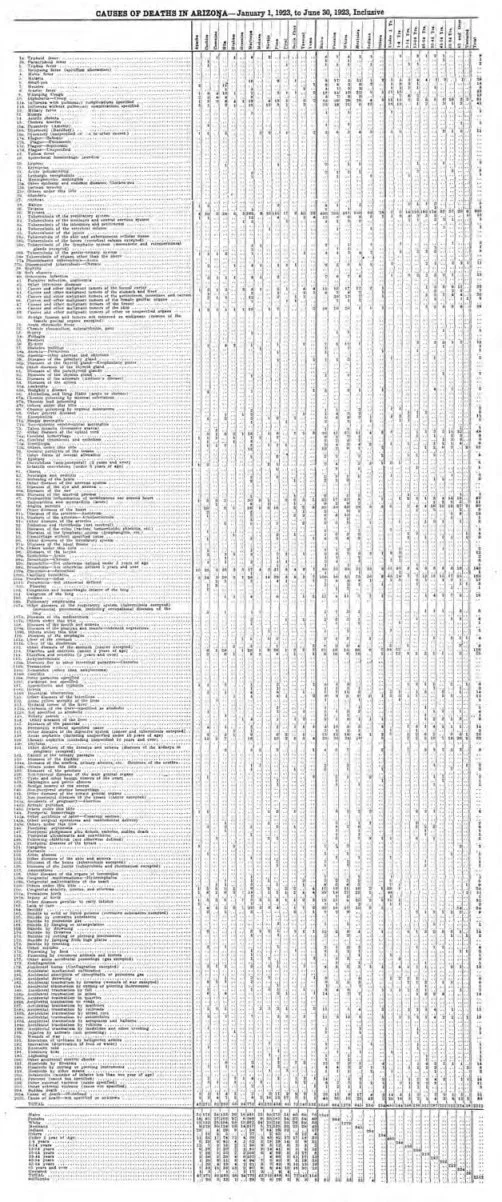
Figure 1. Ruby Jacquemin’s first published table of death statistics. Source: Arizona State Board of Health (1923).
Figure 1 displays the first biannual table of death statistics that Ruby published. The text is difficult to read in the shrunk version displayed in Figure 1 (the original document would have been on a large sheet of paper to make it legible; in later years, Ruby split the table among multiple pages so it could be printed within the Bulletin of the State Board of Health) but the one-page layout makes it easier to see the table structure.
The top section of Figure 1 gives the number of deaths from each cause listed on the left, cross-classified by county (second vertical section), sex and race (third vertical section), and age group (fourth vertical section). The rightmost column totals the deaths from each cause. The bottom section gives the number of county deaths for each sex, race, and age group; the last line contains the number of stillbirths for each county, sex, and race.
What did Ruby need to do to construct this table? According to Arizona’s 1925 Vital Statistics Code, the local registrar was to make copies of all certificates, then forward the originals to the state registrar by the 10th day of each month. Then, the state registrar was to examine the certificates, “and if any such are incomplete or unsatisfactory he shall require such further information as may be necessary to make the record complete” (p. 12).
After obtaining the records (and corrections if needed), Ruby copied the information and created alphabetized card indices of births and deaths. Each month and quarter, she tabulated the births by county, sex, race, parents’ ages, family size, birth order, attendant (physician, midwife, or other) and number of infants delivered.
Tabulating death statistics was more challenging, as Ruby first needed to assign a single cause of death to each certificate. Before 1922, the Bulletin published statistics on 37 causes of death, roughly corresponding to the abridged classification in Wilbur (1913). During those years the second most prevalent cause of death, after tuberculosis, was usually "all other causes" — that is, the cause of death was unspecified. For the first half of 1921, for example, 422 deaths (about 1 out of every 6) had unspecified cause (Arizona State Board of Health, 1921).
Shortly before Ruby took over as statistician, however, Arizona adopted the detailed classification in the 1920 revision of the Manual of the International List of Causes of Death (printed in Davis, 1924). This classification system owed its existence to efforts of the statistical community. In 1891 the International Statistical Institute, recognizing the confusion and lack of comparability caused by every country having its own nomenclature and guidelines, asked French statistician Jacques Bertillon to chair a committee to draft a uniform classification. Bertillon presented his system in 1893, and it was soon adopted by several countries, including all those in North America. The 1920 classification has a menu of 205 causes of death, starting with typhoid fever and other infectious diseases, and ending with external causes of death such as accidents and homicide. The classification used today builds on this scheme.
It was easy to classify the cause of death for a typed death certificate that listed the cause as smallpox. Other certificates, however, were more challenging. Many were handwritten and of varying legibility. Others used nonstandard or imprecise terms, or listed multiple causes of death. How was one to classify a certificate that listed the cause as “encephalitis and measles,” “inflammation,” or “visitation by God”?
The detailed descriptions in Davis (1924) (or the earlier edition of Wilbur, 1913) would have helped. Each of the 205 sections lists specific terms under that classification, and an index provides a cross-reference. The index entries for “inflammation” span three pages and refer to the appropriate classification based on the location of the inflammation. Some causes were still difficult to pinpoint, however: the index entry “God, visitation” links to category 205, “cause of death not specified or ill-defined.” The guidelines in Wilbur (1914) and revised in Davis (1925) stated the preferred classification when a certificate listed multiple unordered causes; for example, “encephalitis and measles” would be classified as measles, the underlying cause.
Ruby’s work, combined with Dr. Fahlen’s efforts to educate physicians on the use of the new standard birth and death certificates adopted in 1923, greatly reduced the unclassified deaths. In Figure 1, about 100 deaths (fewer than 1 in 20) fell in unclassified category 205. By 1928 only 1 out of every 50 deaths was unclassified (Arizona State Board of Health, 1928).
Ruby also calculated numerous other statistics for the Bulletin (and for other reports that no longer exist) and released monthly statistics to state newspapers. She produced special tables of tuberculosis deaths (by race, age, and county). Ruby’s tables of disease cases and deaths identified the laxity of contagious disease reporting. For the first biannual statistics that Ruby compiled in 1923, only one case of influenza was reported to the Board of Health, although 102 deaths were attributed to influenza (AR 08/05/1923). Deaths also greatly outnumbered reported cases for pneumonia and meningitis.
These disparities between reported cases and deaths provided justification for Dr. Fahlen’s efforts to increase compliance with contagious disease reporting requirements. He noted that “for the year 2022 there were 1375 cases of contagious diseases reported with 2328 deaths” but statistics for the first five months 1923 were already showing higher reporting with 2203 cases and 1022 deaths (Arizona State Board of Health, 1930, p. 64). During 1924, the office mailed letters and literature to all 375 physicians, osteopaths, and chiropractors in the state, along with a supply of postage-paid “cards and forms for reporting communicable diseases. There has been a noticeable increase in reporting of diseases since this letter was mailed” (Arizona State Board of Health, 1930, p. 96).
In the 1920s, the standard reference for preparing vital statistics was by Harvard Professor of Sanitary Engineering George C. Whipple (1919). Vital Statistics was essentially a statistics textbook, with chapters on "Statistical Arithmetic" containing sections on tabulation, logarithms, averages, and calculating birth and death rates; "Statistical Graphics"; "Causes of Death"; "Statistics of Particular Diseases" with an emphasis on tuberculosis; "Probability"; and "Correlation." Whipple’s formal education ended with a bachelor’s degree in civil engineering but he became an expert in statistics in the course of his public health work. He wrote the book to emphasize “the need of using vital statistics with truth, with imagination and with power” (p. v).
Whipple (1919) gave a great deal of practical advice on how to display tables and construct graphs. Although the Bulletin contains no graphs prepared by Ruby, Mrs. Howe (1922) drew bar charts to show the leading causes of death of infants and the infant mortality rates by county. Figure 1 can be viewed as a form of graph. The darker patches of ink draw attention to the causes accounting for the most deaths: tuberculosis, pneumonia, diarrhea and enteritis. You can also immediately see the high infant mortality in the marginal totals by age group (the diagonal block in the lower right), and that there are more deaths of men than women (not surprising since in the 1920 census, Arizona had 1.2 men for every woman, and the ratio was 1.4 to 1 for persons over age 45).
Whipple (1919) recommended using mechanical devices for statistical work. The Census Bureau had used Hollerith and similar punch-card machines to tabulate census results since 1890. Arizona would not have been able to afford a Hollerith machine, however, nor would the expense have been justified for such a small state. Ruby’s mechanical help for tabulation took the form of a Burroughs Adding Machine, purchased in 1920 for $230 (Arizona State Board of Health, 1930, p. 41). Ruby would have added numbers by entering the numbers and pulling the lever, subtracted numbers by adding the complement of the subtrahend, and performed multiplication and division by repeated addition and subtraction.
If it seems like Ruby’s statistical work consisted mostly of tabulations, well, that was the focus of most statistical work of the time. Many articles in the Journal of the American Statistical Association (JASA) during the 1920s consisted of tabulations or simple displays of data: summarizing the 1920 Census of Agriculture, graphing bond prices, or comparing population statistics from 1870 to 1920. The journal published some articles that developed new statistical methodology (previewing its later emphasis) but its main focus was on collecting and summarizing data using means, correlations, tables of counts, and line graphs. The first five articles in the September 1926 issue of JASA, on the development of Vital Statistics in the United States, emphasized the need for bringing all states into the registration areas by 1930 so that national tabulations would include the entire country. No fancy statistical methods were mentioned in these articles — the goal was to improve the data collection to obtain accurate counts and rates of births and deaths.
Importance of High-Quality Data
In the first statistics class I took as a graduate student, Professor William G. Hunter stressed the fundamental importance of collecting good data: “If the experimental design is wisely chosen, a great deal of information in a readily extractable form is usually available, and no elaborate analysis may be necessary. In fact, in many happy situations all the important conclusions are evident from visual examination of the data” (Box, Hunter, and Hunter, 1978 p. 7). If you collect good data, through a well-designed census, sample survey, or experiment, you often don’t need to use complicated statistical methods to analyze the data. The statistical information jumps out at you.
Professor Hunter also insisted that his students “make friends with the data.” Ruby, through her work in recording, classifying, and tabulating the certificates, would have known the data inside and out. Familiarity with the data makes it easier to see patterns and to spot anomalies and shortcomings. Computing methods (and now, AI tools) have made calculations easier, but they can also distance the statistician from the data if used thoughtlessly. Ruby would have known which local registrars were providing high quality data and which areas needed improvement, and she and Dr. Fahlen would have been able to use her deep knowledge of the data to improve Arizona’s registration and disease reporting systems.
Ruby Jacquemin and Frederick Fahlen worked hard during the 1920s to improve the quality of Arizona’s vital statistics data. They standardized the birth and death certificates, sent blank forms to the local registrars, followed up on incomplete or obviously erroneous certificates, distributed literature (in English and Spanish) on how and why to report deaths, and reduced the percentage of deaths with ill-defined cause. Dr. Fahlen and Mrs. Howe spoke all around the state about the importance of registration. Mrs. Howe and her team of nurses encouraged new and soon-to-be mothers to register their babies, and distributed thousands of pamphlets titled “Is your baby registered?” and “¿Está su niño registrado?” that described the benefits of registration.
Their efforts were rewarded when the Census Bureau concluded in 1926 that Arizona’s registration systems captured more than 90 percent of the state’s births and deaths, and Arizona was admitted into the federal birth and death registration areas. But were the registers as complete as the Census Bureau claimed?
Next: How did the Census Bureau conduct the survey that approved Arizona’s vital statistics?
Copyright (c) 2026 Sharon L. Lohr
AcknowleDgments
I am grateful to the staff and volunteers at the Sharlot Hall Museum and Research Center, the Prescott Public Library, the Prescott Elks Theatre, and the Arizona State Archives for their insights and help in locating material relating to Ruby Loy’s early years in Prescott and the history of vital statistics in Arizona.
Footnotes and References
¹Yavapai County resident Frances Munds, who led suffrage initiatives for Arizona and the nation, wrote: "One of the most important events during my life as a teacher was the removal of the Capitol of Arizona from Prescott to Phoenix. The people of Yavapai County were very indignant over the steal as they called it…. Anyhow, the Capitol was stolen, so we say in this county, from Prescott and taken via the old Prescott and Arizona Central railroad and loaded on to the Santa Fe and taken to Los Angeles and loaded on to the Southern Pacific and by some other circuitous route finally reached Phoenix and no one has been able to pry it loose from there in all the years since” (Munds, 1941, p. 30).
²Early Census Bureau tables, however, provide some information on the probable grounds for this divorce. Table 8 from U.S. Bureau of the Census (1908, p. 219) lists nine divorces for 1896 among Arizona couples married eight years: three granted to the husband for the wife’s desertion, and six granted to the wife (one for drunkenness, one for desertion, two for neglect to provide, and two for a “combination of the preceding causes”). If James was petitioner (which is likely since the divorce was granted in Flagstaff), then the grounds must have been desertion. Desertion was the most common grounds for divorce in Arizona between 1887 and 1906, accounting for 70 percent of the 797 divorces granted to men and 41 percent of the 1,585 divorces granted to women (U.S. Bureau of the Census, 1908, pp. 5-6). The timing of the divorce, two years after James moved to Flagstaff, also suggests grounds of desertion, since the Howell Code allowed divorce “[w]hen either party shall desert the other for a period of two years” (p. 232). James divorced his second wife Mary on grounds of desertion (actually, Mary, who married James in 1902, filed for divorce first but the court denied her 1917 petition; it granted James’ petition for divorce in 1918; PJM, 1/25/1917, 1/20/1918).
According to the U.S. Bureau of the Census (1909, p. 77), alimony was granted in only 93 (3.9 percent) of the 2,380 Arizona divorces recorded between 1887 and 1906. However, the report notes that these statistics include only alimony “secured as an incident to the divorce suit.” Alimony secured in a separate suit, or other spousal support, is not included (p. 33; see also Melcher, 2018). James may have provided some financial support for Ruby even if there was no official alimony.
³Then again, Ruby was surrounded by strong women. Her mother, Sarah, had left Missouri as a young woman to become an Arizona pioneer (AR, 04/14/1926, 10/31/1944). After the divorce, she supported herself and Ruby as a dressmaker, one of the few occupations available to women in the 1890s. In 1918, she moved to Phoenix to live with Ruby and stayed there until her death in 1944.
Ruby’s stepmother Mary Dillon Loy, who lived about two blocks from Sarah and Ruby in Prescott, worked alongside Frances Munds in the petition drive to place women’s suffrage on the ballot and the subsequent campaign to pass the initiative. On November 7, 1912, two days after the men of Arizona approved suffrage (by a vote of 13442 to 6202), Mary filed her petition to run for mayor of Prescott on the Socialist ticket, becoming one of the first women in Arizona to stand for public office. She lost the election to the Democratic candidate, but earned 192 votes to his 691 (PJM, 11/08/1912, 01/08/1913). Mary’s suffrage colleague Frances Munds won her election to become state senator two years later.
Newspapers and other archives circa 1900 have only a few references to Ruby, Sarah, and Mary. James Loy, by contrast, appears frequently in the newspapers of the time (the data of history are decidedly not missing completely at random!). The 1870 and 1880 censuses list James as living in Yavapai County, and he spent his early years ranching. In 1887 James was charged with drawing a pistol on W. E. Lockwood; after two juries could not agree, the charges were dismissed and Loy subsequently sued Lockwood (AC 04/09/1887). He was also involved in several other lawsuits during the 1880s (this may have motivated his decision to become an attorney). He ran unsuccessfully for probate judge of Coconino County in 1896 but won the county election for district attorney in 1898 (by 20 votes; CS, 11/12/1898). After his term ended in 1900, he moved to Phoenix and then returned to Prescott (with Mary) where he practiced law. James ran for state Attorney General after his second divorce in 1918. He received about 12 percent of the votes in the Democratic primary, following a blistering campaign in which he called his primary opponents barnacles who “sucked the political teat” and told them to “watch my smoke on primary day” (AR, 08/12/1918). James Loy’s death certificate in 1926 listed his cause of death as “arteriosclerosis myocarditis.” Ruby, as statistician for the Board of Health, would have had to resolve the multiple causes on this certificate.
⁴The U.S. Public Health Service (1926) report named only the state registrar for large states, but we know that numerous women on registrars’ staffs processed and tabulated the data. In 1916, the New Jersey vital statistics office employed seven clerks, five of whom were women; the Pennsylvania registrar, chief clerk, classification clerk, returns clerk, and tabulating machine operator were men, but the three stenographers, five typists, and 15 clerks were all women. Women also compiled vital statistics at the national level during the 1920s. National mortality reports, publishing death statistics for the states and territories admitted to the registration area, acknowledged “the efficient service rendered in the preparation of this report” by Miss Maud E. Linder.
References
Background material on Ruby Jacquemin is from the Arizona Champion (AC), Arizona Gazette (AG), Arizona Journal-Miner (AJM), Arizona Republic (called the Arizona Republican until 1930, AR), Arizona Weekly Journal-Miner (also called Weekly Arizona Journal-Miner, AWJM), Coconino Sun (CS), Prescott Journal-Miner (PJM), and Cassagio (2017). For readability, I listed the issue and page number only for quoted material from the newspapers. Munds (1922) and deHaan (2004) describe the history of women’s suffrage in Arizona.
Arizona State Board of Health (1921). Arizona deaths, first half of 1921. Bulletin of the Arizona State Board of Health, IX(18), July, 12.
Arizona State Board of Health (1923). Causes of deaths in Arizona—January 1, 1923 to June 30, 1923, inclusive. Bulletin of the Arizona State Board of Health, XII(26), July. The table is appended at the back of the Bulletin.
Arizona State Board of Health (1928). Causes of deaths in Arizona (by ages): First six months of 1928. Bulletin of the Arizona State Board of Health, No. 47, October, 22-39.
Arizona State Board of Health (1930). Minutes, 01/1919-12/1930. In RG 050 Arizona Department of Health Services SG 01 Board of Health, Volume 4, Arizona State Archives.
Box, G. E. P., Hunter, W. G., and Hunter, J. S. (1978). Statistics for Experimenters. New York: John Wiley & Sons.
Cassagio, J. (2017). The Loy Family. Document prepared for the Cornville Historical Society, https://www.flagstaff.az.gov/DocumentCenter/View/88222/Loy-Building-History; also see https://public.destinyhosted.com/flagsdocs/2025/HPC/20250319_4266/AGENDApacket__03-19-25_1040_4265.pdf.
Davis, W. H. (1924). Manual of the International List of Causes of Death, Based on the Third Decennial Revision by the International Commission, Paris, October 11 to 15, 1920. Washington, DC: US Government Printing Office.
Davis, W. H. (1925). Manual of Joint Causes of Death Showing Assignment to the Preferred Title of the International List of Causes of Death When Two Causes Are Simultaneously Reported, 2nd ed. Washington, DC: US Government Printing Office.
deHaan, A. (2004). Arizona women argue for the vote: The 1912 initiative campaign for women’s suffrage. Journal of Arizona History, 45(4), 375-394.
Hetzel, A.M. (1997). History and Organization of the Vital Statistics System. Hyattsville, MD: National Center for Health Statistics.
Howe, Mrs. Charles R. (1922). The Sheppard-Towner Act. In Bulletin of the Arizona State Board of Health, X(22), July, 3-7.
Jacquemin, R. (1973). How I became interested in stamp collecting. The Arizona Philatelist, 15(6), 38.
Leon, C. B. (2016). The life of American workers in 1915. Monthly Labor Review, U.S. Bureau of Labor Statistics, February 2016, https://doi.org/10.21916/mlr.2016.5
Melcher, M. (2018). Divorce in the desert: Unhappy marriages and female autonomy in Arizona, 1870-1930. Journal of Arizona History, 59(4), 279-304.
Munds, F. W. (1922). Arizona. In The History of Woman Suffrage, Vol. VI, ed. I. H. Harper. New York: J.J. Little & Ives Company, 10-15.
Munds, F. W. (1941). Reminisces of a Pioneer Teacher of Yavapai County, Arizona. Munds Collection, Sharlot Hall Museum Research Center.
Oswald, W. E. (1945). A History of Public Schools in Prescott, Arizona. MA Thesis. Greeley, CO: Colorado State College of Education.
U.S. Bureau of the Census (1909). Marriage and Divorce, 1867-1906 Part I. Washington, DC: US Government Printing Office.
U.S. Bureau of the Census (1908). Marriage and Divorce, 1867-1906 Part II. Washington, DC: US Government Printing Office.
U.S. Public Health Service. (1926). State and insular health authorities, 1926. Public Health Reports, 41(35), 1824-1845.
Whipple, G. C. (1919). Vital Statistics: An Introduction to the Science of Demography. New York: John Wiley & Sons, Inc.
Wilbur, C. L. (1913). Manual of the International Classification of Causes of Death, Based on the Second Decennial Revision by the International Commission, Paris, July 1 to 3, 1909. Washington, DC: US Government Printing Office.
Wilbur, C. L. (1914). Index of Joint Causes of Death, Showing Assignment to the Preferred Title of the International List of Causes of Death When Two Causes Are Simultaneously Reported. Washington, DC: US Government Printing Office.
Williams, R. C. (1922). Public Health Administration in Arizona. Public Health Bulletin No. 122. Washington, DC: US Government Printing Office.