Happy 100th Anniversary, Arizona (With an Asterisk?)
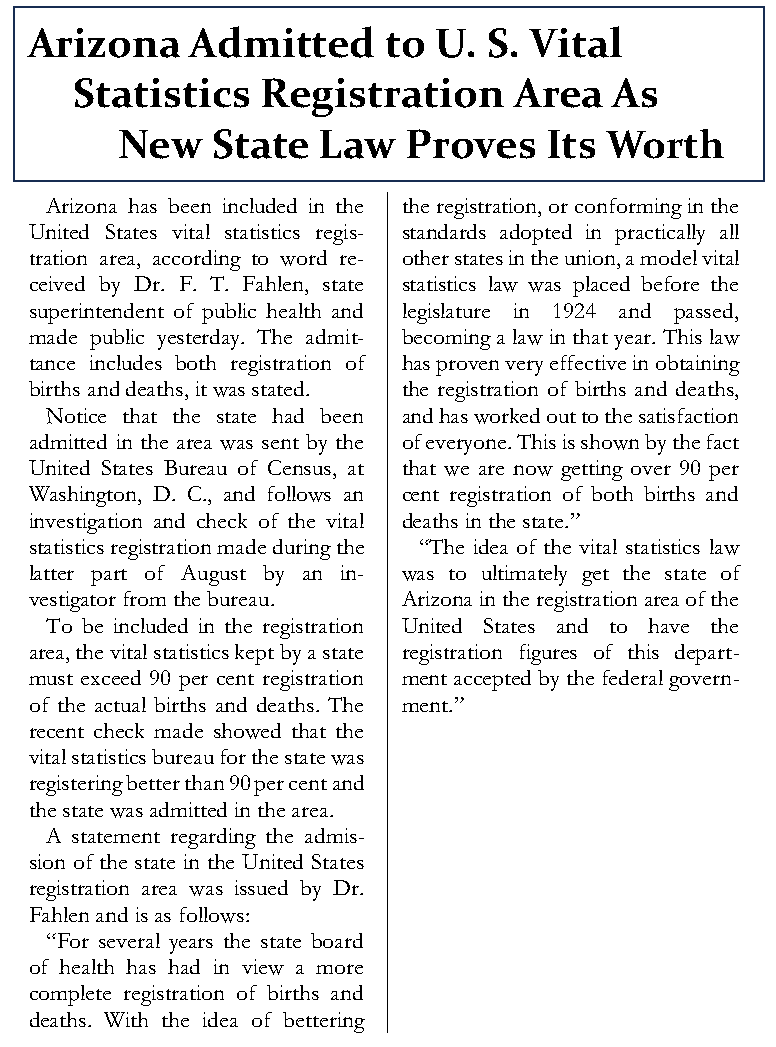
Figure 1. Reproduction of Arizona Republican article from September 21, 1926, page 8.¹
September, 2026 marks the 100th anniversary of Arizona’s admission into the federal birth and death registration areas. The last step needed for admission was a survey that, according to the Census Bureau, demonstrated that Arizona’s system of collecting vital statistics captured at least 90 percent of the state’s births and deaths (see FIgure 1).
But did the survey really demonstrate that level of completeness? Or should Arizona’s admission to the registration areas have come with an asterisk?
Let’s look at the circumstances of Arizona’s admission. In Part 1 (this post), I’ll briefly review vital statistics in Arizona’s territorial and early statehood days, and examine what motivated the need for accurate vital statistics.
The article reproduced in Figure 1 quotes Dr. F. T. Fahlen, the state superintendent of the Board of Health. But the Board statistician in 1926, the person who actually collected and tabulated the statistics, was a young widow named Ruby Jacquemin. In the 1920s, women did much of the statistical work, and Part 2 explores Ruby’s background and contributions.
Part 3 examines the survey data collected by the Census Bureau in 1926 to examine coverage. How were the data collected, and did the survey really demonstrate a coverage of 90%?
Arizona and Vital Statistics
The first territorial legislature did not appear to view vital statistics — which are, literally, the statistics of life and death — as having vital importance. The Howell Code of 1864 — the first set of laws enacted in Arizona Territory — required county recorders to keep records of deeds and marriages but not of births and deaths. Registration of births and deaths was first specified in the Revised Statutes of 1887, which required physicians and accouchers (or next of kin, or owner of the house where the death occurred, or person discovering the death) to report each birth or death within 30 days to the county recorder (Arizona Statewide Archival and Records Project, 1941).
Vital statistics in Arizona became more standardized in 1909 with the establishment of the Bureau of Vital Statistics, which was given “authority to prepare methods, forms, and blanks for the purpose of insuring registration and preservation of records of births and deaths” (Arizona Statewide Archival and Records Project, 1941, p. 23).²
But it is one thing to enact a law requiring registration of births and deaths, and another to collect accurate information on every birth and death in the territory (or state, after 1912). Many areas of Arizona faced challenges for implementing the 1909 law. More than two-thirds of Arizona’s population lived in rural areas and many were isolated. Physicians (who, together with midwives and undertakers, were tasked with reporting births and deaths) were scarce outside of the main towns.
Coverage of deaths was thought to be more comprehensive than that of births, perhaps because a death certificate was required for burial, but in the early years after the 1909 law both types of records had many holes. Various state superintendents of health (who also served as the registrars of vital statistics) documented shortcomings and exhorted physicians and midwives to comply with the law.
Dr. Edward Godfrey, the last Territorial superintendent, submitted the table of vital statistics for 1907-08 "for what it is worth. That it is far from being complete is indicated by the death rate exceeding the birth rate" (Godfrey, 1908, p. 4). He identified a major reason for the inadequate statistics: a “paucity of funds,” which were not even sufficient to hire a stenographer to tabulate the returns (Godfrey, 1912, p. 3). Dr. Robert Looney (1912), the first superintendent after Arizona’s statehood, also noted the excess of deaths over births as evidence of the statistics’ incompleteness.
Dr. George Goodrich (1920a, p. 7) wrote: “One part of the work of our office has been to awaken among the physicians of the State a realization of the necessity of obeying the laws as to the reporting of infectious diseases and the filing of birth certificates and death certificates as the statutes require. Some of the physicians in the State have been conscientious in complying with all regulations. Others, and they have been in the decided majority, have simply ignored many parts of the laws.” He called physicians who fail to report births promptly “a public nuisance. They not only inflict a wrong on the community but are subjecting defenseless children to the possibilities of great inconvenience and heavy loss later in life” (Goodrich, 1920a, p. 3).
A plan implemented by Mrs. Charles R. Howe, who was appointed director of the new state Child Welfare Bureau in 1919, seems to have done more to improve birth registration than the superindendents’ exhortations and scolding.³ When a birth certificate was received by the state Bureau of Vital Statistics, Mrs. Howe sent a card to the mother listing the information that had been recorded about the birth, along with literature (in English or Spanish) on how to care for the baby. This gave the mother the opportunity to correct erroneous or missing information (for example, many births were recorded before the baby was named, so the mother could file a supplementary certificate giving the baby’s name); it also raised awareness of birth registration as other mothers wondered why they did not receive cards and literature (Goodrich, 1920c; Williams, 1922).
Mrs. Howe and her staff also checked whether babies they encountered in child welfare clinics and other encounters were registered. These investigations, and discoveries that there were no birth certificates for numerous infants who had death certificates, led Dr. Goodrich (1920b) to conclude that about ten percent of births were not registered with the state. Mrs. Howe described one of her activities: "A birth registration check was made of all Arizona born children, of which there were two hundred and eighty. Of this number nineteen had not been registered at all, four were registered but incomplete for lack of christian names, and five were incorrectly registered" (Howe, 1923, p. 4).
The Census Bureau had three requirements for a state to be admitted into the registration area for births or deaths. These were intended to provide for uniformity in data collection (so states were measuring the same things) and establish that a state’s registered births and deaths were accurate.
The state legislature needed to enact a Vital Statistics Act that was consistent with the Census Bureau’s Model Vital Statistics Law (found in American Medical Association, 1919, pp. 13-41). The Act was to make it mandatory to register births and deaths, specify the timeline and process for registration, and ensure that birth and death certificate forms collected, at a minimum, the 23 pieces of information for births and the 20 pieces of information for deaths. Arizona enacted a preliminary version in 1909 and a version conforming with the Model Law in 1925.
The state needed to establish systems for accomplishing the registration called for in the legislation. Arizona had procedures prior to the 1925 Act, but continued to improve them.
The state registration systems had to be demonstrated to include at least 90 percent of all births and deaths in the state.
The third requirement was the tricky one, and in Part 3, I’ll talk about the survey used to measure registration completeness. But the state had apparently done enough to receive the Census Bureau’s seal of approval, and Arizona’s 1926 statistics were published along with the rest of the states in the registration areas (U.S. Bureau of the Census, 1929a, 1929b).
What Did Arizona Gain by Admittance?
What motivated Arizona’s public health leaders to push for accurate vital statistics and for admission to the federal birth and death registration areas? I think there were seven major factors:
Statehood aspirations and state pride. Arizona had been applying for statehood as early as 1883, but while other states were admitted shortly after they asked, it took Arizona until 1912 to become the 48th state (see Andrews, 2026 and Goodykoontz, 2026 for entertaining descriptions of Arizona’s convoluted path to statehood). Through the 1909 Vital Statistics Act, the Territorial Legislature was saying that Arizona could keep records and fulfill functions expected of a state just as well as the territories that had been granted statehood.
Dr. Godfrey wrote: “Public hygiene is one of the best indices of the civilization of a country or a state…. Arizona by showing her ability to deal with the more advanced problems of government will once again demonstrate her fitness for statehood. She has the fitness, what that fitness needs is advertising, and in taking her place at the head of the registration states she will procure it in a peculiarly convincing way to the country at large” (Godfrey, 1909, pp. 2-3).
Dr. Goodrich echoed this reasoning: “If Arizona is to maintain her reputation for progressive legislation, she must adopt the ‘Model Law’ for vital statistics. Already we have received too much unenviable publicity as being one of the five states whose system of registration of births and deaths is inadequate and out of date” (Goodrich, 1920d).
Progressivism. As Dr. Goodrich mentioned, Arizona was a progressive state.⁴ Progressives, who embraced scientific medicine, increasingly relied on statistics to measure progress toward public health goals (Boster and Pugno, 2024, ch. 9; Tomes, 2010). After admission to the registration areas, Arizona’s statistics were viewed as reliable, and could be included in the national statistics and compared with those of other states. The standardized reporting procedures gave Arizona statistical information on causes of death for every county in the state, crucial for public health planning.
A state-federal cooperative system. The federal vital statistics system was set up so that states were in control of the recordkeeping. Since national statistics typically took a couple of years to compile and publish, a state such as Arizona, which released statistics monthly to the newspapers and published them biannually in the Bulletin, could identify public health problems long before national statistics were available.
Arizonans’ need for officially accepted documents. Acceptance into the registration areas gave Arizona’s birth and death certificates the imprimatur of the federal government, which would increase confidence that Arizona’s documents were properly prepared, and therefore valid for establishing identity, age, citizenship, and eligibility for inheritance, pensions, and insurance.
High infant mortality. In the 1910s and 1920s, about one out of every five recorded deaths in Arizona was of an infant less than one year old (see Figure 2). Many infants died from causes that are almost entirely preventable today — measles, diphtheria, pertussis, polio, smallpox, tuberculosis, and diarrheal disease.⁵ Accurate infant mortality rates, calculated as the number of infant deaths per 1,000 live births, would require both accurate death statistics for the numerator and accurate birth statistics for the denominator.
Tuberculosis. In most of the years depicted in Figure 2, tuberculosis was the leading cause of death in Arizona. Tuberculosis patients from other states came to Arizona for the climate, and all too often stayed only to become part of the vital statistics within a few months. Williams (1922, p. 19) noted: “The morbidity reports on tuberculosis are entirely inadequate.” In most years Arizona’s statistics showed more deaths from the disease than reported cases, and surveys in Phoenix, Tucson, and Prescott found large numbers of cases of active tuberculosis that were not showing up in the official statistics.
Influenza pandemic of 1918. The pandemic reached Winslow, Arizona during the last week of September, 1918 and spread rapidly through the state. The state Board of Health and local physicians were so overwhelmed by dealing with the pandemic (and many physicians themselves became infected and died) that vital statistics were largely neglected.⁶ The system thus missed many influenza deaths (Dahal et al., 2018). But the incomplete statistics were horrifying enough (see the spike in Figure 2). Dr. Goodrich reported 2,005 deaths from influenza and pneumonia from October to December, 1918 (Goodrich, 1919, p. 6).
Just as the 1831 cholera epidemic spurred the 1836 legislation calling for birth and death registration in Great Britain (which in turn inspired Lemuel Shattuck, one of the founders of the American Statistical Association, to push for similar legislation at home) the 1918 influenza pandemic led to calls for more accurate vital statistics throughout the United States, including in Arizona.
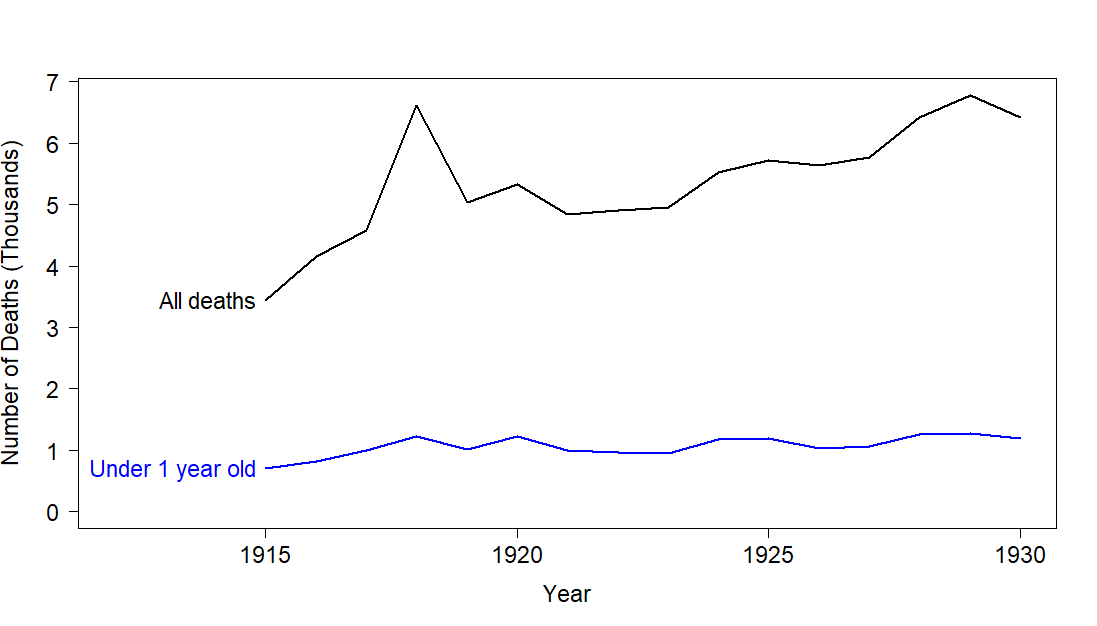
Figure 2. Deaths recorded in Arizona from 1915 to 1913. The black line shows total deaths, and the blue line shows the number of deaths of infants less than one year old.⁷
Dr. John Flinn was one of the strongest voices promoting the Territorial Vital Statistics Act of 1909. He called preventive medicine the “most important branch of medical science” and described its successes in reducing typhoid fever and smallpox. He wrote eloquently of the need for accurate statistics for identifying public health problems and measuring progress:
But, if a systematic and concerted attack is to be made on the strongholds of disease, obviously the very first step is to obtain accurate information regarding the enemy's strength, the frequency and extent of his ravages and the exact number of killed and wounded. Accurate data regarding disease is best gotten by systematic and uniform system of registration of births and deaths, with full information regarding both” (Flinn, 1914, pp. 3-4).
In 1926, Arizona’s vital statistics were approved by the Census Bureau. Who compiled and presented these statistics? The next part in this series looks at the life and work of Ruby Jacquemin, Arizona’s public health statistician during most of the 1920s.
Copyright (c) 2026 Sharon L. Lohr
Footnotes and References
¹Archived copies of Arizona Republican articles from the early part of the 20th century are often blurred and difficult to read. Figure 1 contains a retyping of the article, with typeface and formatting similar to the original.
²In 1903 the Legislature had assigned responsibility for keeping birth and death records to the newly created Territorial and County Boards of Health, but recordkeeping was spotty, particularly for births. The 1909 Arizona law roughly followed the procedures and certificate information specified by the 1907 “Model Law” that had been crafted by the Census Bureau to promote uniformity among states and territories. The Bureau of Vital Statistics was placed within the Territorial Board of Health. Many of the birth certificates online at the Arizona Genealogy Record Search for persons born in 1909 are “delayed,” created decades later when the person needed proof of birth to establish identity or receive benefits.
³I could not find Mrs. Howe’s own first name; she seems to have only been referred to as Mrs. Charles R. Howe.
⁴One measure of that progressivism was the 1912 passage of woman’s suffrage with more than 2/3 of the vote. It was also reflected in the establishment of the Child Welfare Division, which later received funds through the Sheppard-Towner Maternity and Infancy Protection Act of 1921. The Sheppard-Towner Act was the first major legislation enacted after full national women’s suffrage was achieved in 1920, and was heavily supported by progressive women such as Julia Lathrop and Florence Kelley.
⁵The preventability of these deaths is attested by the dramatic reduction of infant mortality achieved over the past century in the United States, from one out of five deaths in 1926 to one out of 153 deaths nationally in 2024 (and about one out of 166 deaths for Arizona; the Arizona 2024 infant mortality rate, at approximately 5.2 infant deaths per 1,000 live births, was also below the national rate of 5.5). Globally, however, diarrheal disease is the third leading cause of death of children under age 5.
⁶Goodrich (1920a) documented the chaos that the pandemic had caused in the state’s vital statistics program. His predecessor had not kept up with tabulating statistics sent by local registrars, and it was “probable that the physicians themselves neglected these very necessary details since most of them were laboring under the stress of overwork due to the epidemic” (Goodrich, 1920a, p. 5). He wrote that his office, however, had tried to catch up on the vital statistics during 1919, a task complicated by the fact that his predecessor had used up all of the office’s budget for the first six months of 1919.
⁷I obtained the statistics used in Figure 2 from the Bulletins and Biennial Reports of the Arizona State Board of Health, available at https://azmemory.azlibrary.gov. If there were discrepancies between statistics in these sources, I took the version in the Bulletin. There was some confusion about the 1922 statistics, since no table for January to June deaths appeared in the Bulletin (the July to December table was published twice); I obtained the January to June statistics from page 5 of the Arizona Republican issue of December 7, 1922. Of course, all of these statistics are to be interpreted in light of the incomplete data (especially from the earlier years), the suspension of recordkeeping during the influenza pandemic, and the increase of Arizona’s population over the time span. I presented death numbers rather than death rates because population estimates are only available for decennial census years.
American Medical Association (1919). Why Should Births and Deaths Be Registered; A Summary of the History and Present Condition of Vital Statistics Laws, Including the Text of the Model Bill. Chicago: American Medical Association. .
Andrews, C. (2026). Arizona’s path to statehood: How the desert’s last holdout joined the union. https://infoarizona.com/path-to-statehood/
Arizona Department of Health Services (ADHS, 2012). Arizona Health Services Through the Century. https://www.azdhs.gov/documents/director/history/ADHS-Historical-Timeline.pdf
Arizona Statewide Archival and Records Project (1941). Guide to Public Vital Statistics Records in Arizona. Phoenix: Arizona Statewide Archival and Records Project.
Boster, D. and Pugno, B. (2024). A History of Western Medicine, Disease and Public Health Since 1700. Columbus, OH: Columbus State Community College.
Dahal, S., Jenner, M., Dinh, L., Mizumoto, K., Viboud, C., and Chowell, G. (2018). Excess mortality patterns during 1918–1921 influenza pandemic in the state of Arizona, USA. Annals of Epidemiology, 28(5), 273-280.
Flinn, J. W. (1914). Vital statistics and their relation to preventative medicine. Bulletin of the Arizona Territorial Board of Health, III(7),, July, 3-11.
Godfrey, E. S. (1908). Vital statistics, 1907-1908. In Bulletin of the Arizona Territorial Board of Health,II(1), December, 3-4.
Godfrey, E. S. (1909). Some observations on the new registration law. In Bulletin of the Arizona Territorial Board of Health,I(1), November, 2-3.
Godfrey, E. S. (1912). Some observations on the new registration law. In Bulletin of the Arizona Territorial Board of Health,II(1), November, 2-3.
Goodrich, G.E. (1919). The influenza pandemic. In Bulletin of the Arizona State Board of Health, VII(9), April, 5-6.
Goodrich, G.E. (1920a). Arizona’s health activities. In Bulletin of the Arizona State Board of Health, VIII(12), January, 5-7.
Goodrich, G.E. (1920b). Editorial comment. In Bulletin of the Arizona State Board of Health, VIII(13), April, 3-4.
Goodrich, G.E. (1920c). The Child Welfare Bureau. In Bulletin of the Arizona State Board of Health, VIII(13), April, 12-14.
Goodrich, G.E. (1920d). Vital statistics and the model law. In Bulletin of the Arizona State Board of Health, VIII(13), October, 7.
Goodykoontz, B. (2026). Arizona is the 48th state. Here's the wild reason it took so long. The Arizona Republic (Feb 9),
Hetzel, A.M. (1997). History and Organization of the Vital Statistics System. Hyattsville, MD: National Center for Health Statistics.
Howe, Mrs. Charles R. (1923). Child hygiene division. In Bulletin of the Arizona State Board of Health, XI(24), January, 3-6.
Looney, R.N. (1912). Vital statistics. In Bulletin of the Arizona State Board of Health, II(3), October, 10-12.
Tomes, N. (2010). “Destroyer and teacher”: Managing the masses during the 1918–1919 influenza pandemic. Public Health Reports, 125, 48-62.
U.S. Bureau of the Census (1929a). Birth, Stillbirth, and Infant Mortality Statistics for the Birth Registration Area of the United States, 1926, Part I. Washington, DC: U.S. Government Printing Office.
U.S. Bureau of the Census (1929b). Mortality Statistics, 1926. Twenty-seventh Annual Report, Part I. Washington, DC: US Government Printing Office.
Williams, R. C. (1922). Public Health Administration in Arizona. Public Health Bulletin No. 122. Washington, DC: US Government Printing Office.